Thegns of Mercia
  • About Us
  • Services
    • Living History >
      • Events Calendar
    • Talks & Workshops
    • Reconstructions
    • Recent Reconstructions
  • TV & Film
  • Blog
  • Contact Us

​Secrets in the Stones: Decoding Anglo-Saxon Art (Introduction)

1/3/2023

Comments


​Secrets in the Stones: Decoding Anglo-Saxon Art
Introduction

This introduction is the first instalment of a series. For other chapters click here.
Picture
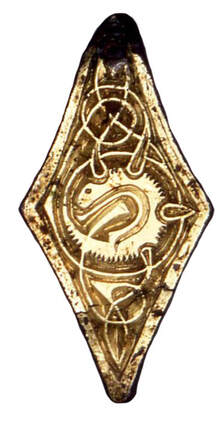
Once dismissed as frivolous and merely decorative, Anglo-Saxon artwork is increasingly recognised to be loaded with hidden meaning, but we have barely begun to decode this visual language. Doing so offers the potential to transform our understanding of this historical cultural network of the so-called “Dark Ages” as a significant world civilization.

New research by Thegns of Mercia member James D. Wenn, focused on a seemingly unrelated subject area, and a series of chance discoveries, have led to transformative new learning perspectives with wide-ranging implications. A book (to be published soon) will lay out many of these discoveries, with key concepts discussed in an upcoming public lecture in April 2023, but neither can fully document the application of these new perspectives on the corpus of Anglo-Saxon art. In the coming weeks we will, therefore, be publishing a special series of articles, here, which will explore the decoding of Anglo-Saxon art made possible by these perspectives.


Read More
Comments

Shield of an Anglo-Saxon Prince - Part 3:  Painting

25/4/2022

Comments

 
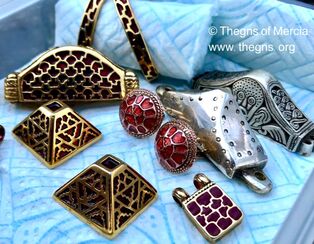
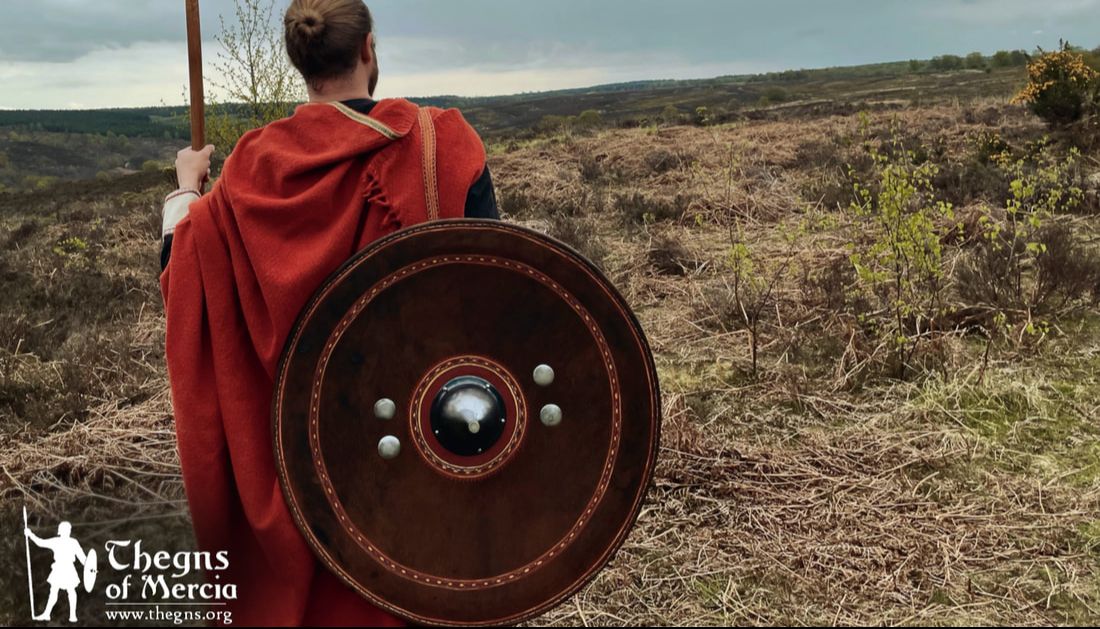
Compared to the famous shield from Sutton Hoo Mound 1, the shields from the other treasure-filled princely Anglo-Saxon burials lack ostentatious decorative fittings. In the first chapter (link) we discussed the striking similarity of these shields, which appeared to be high-performance gear for warrior princes, optimised for agility rather than ostentation. In the second chapter (link) we reported on our project to produce an authentic replica of such a shield, and explore just how light weight they could have been. 
Picture
Despite the minimal fittings, its hard to imagine the shields of the late 6th century princely burials were entirely plain, and new evidence has come to light concerning early Anglo-Saxon paints, and the painted designs preserved from the late Iron Age, which has allowed us to more confidently wade into the painting of early Anglo-Saxon shields for the first time.
​
Researching and experimenting these paints, exploring the evidenced designs, and how they relate to decorative motifs seen in other media across both Anglo-Saxon material culture and adjacent cultures, we were finally able to finish our replica princely shield with a plausible painted design.

Read More
Comments

'Shoddy' Sheaths; Rethinking some early medieval leatherwork

12/4/2021

Comments

 
Picture
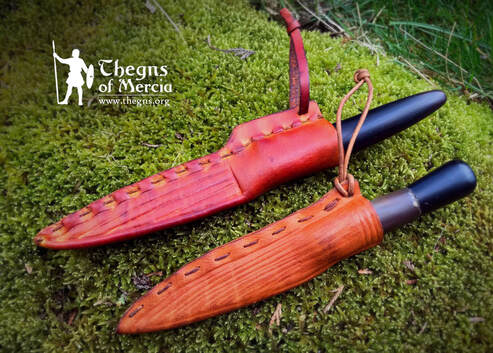
 ​In the frequently damp environment of early medieval Britain and western Europe sheaths were essential for valuable ferrous blades, including swords, war-seaxes and smaller utility knives. The sophisticated and labour-intensive construction of sword scabbards, formed of animal-hair lined carved wooden plates enclosed in leather or hide (“skin product”) is evidence of the priority given to protecting blades. Well preserved examples of seax sheaths, mainly from productive leatherworking sites of the mid-to-late Anglo-Saxon period, at York and Gloucester (Cameron, 2000) as well as more trace evidence from earlier grave finds, demonstrates the high level of craftsmanship which went into these, usually of a single piece of folded and moulded skin-product, sometimes intricately decorated, as might be expected given that the sheath, and not the blade, was the most visible component of any seax assemblage day to day and therefore an important surface for wealth display. Vastly more common but nevertheless valuable personal possessions and often of sophisticated smithcraft, smaller utility and eating-knives also required tight-fitting sheaths of valuable skin-product, but despite the abundance of such knives in the archaeological record, for a wide range of reasons clues about the sheaths of smaller knives are scarcer than for larger seaxes.  

It might be reasonable, and has been the practice among more detail-oriented living historians and reenactors, to assume that sheaths of smaller knives in, for example, the early Anglo-Saxon period, might be miniature analogues of those of larger seaxes, yet fragmentary sheath remains from a handful of well-studied early Anglo-Saxon sites appear surprisingly crude, with amateurish stitching having unattractively contorted the seams in a way that might disgust a modern leatherworker. There is no reason not to think these examples are not well representative, and indeed, many of the later (Viking-Age) knife-sheath remains from York, though often skilfully decorated, bear the tell-tale marks and contortions of this same rudimentary stitch work.
​
It is always tempting to base the sheaths of our knives on the very fanciest, and neatest archaeological examples to hand, and perhaps neaten them up with some more modern handiwork, but this can lead to a creeping departure from what is truly known of the historic craft culture purportedly represented. In contrast, replicating (to our modern eyes) “unbecoming” examples might provide useful, practical insights into why they were made this way.  Such is the case with these apparently crudely stitched knife sheaths – our experiments in replicating them have revealed what might be a cunning Dark Age leatherworker’s “life-hack” which made the tricky shaping of sheaths vastly quicker and more reliable.


Read More
Comments

"Anglo-Saxon" and "Viking" Mens Hairstyles

7/2/2021

Comments

 
In our presentations we endeavour to create convincing and well-researched impressions of the dress and accoutrements of people of particular cultures, sub-periods (ideally century, half-century or even decade) and of particular status or societal role. Recently there has been a trend towards re-creation of assemblages from specific graves, though most such contexts fall well short of providing sufficient evidence on which to entirely base all details of costume, let alone other more ephemeral aspects of appearance.  ​One such matter is that of hairstyle. We very frequently encounter individuals with very strong opinions on the matter of what hairstyles the people of late- 
Picture
"Criticise our haircuts one more time, I dare you..."
antiquity or early medieval period would have had, and are keen to point out how wrong we are, for our variously either “too modern” or “too clichéd” haircuts. Such criticism raises two questions;  What do we really know about the hairstyles of nominally “Anglo-Saxon” and “Viking” period peoples?    What is our group’s authenticity policy with respect to this issue?
In this article we hope to address both questions with respect to male hairstyle and grooming, with a further article on womens’ hair and head-wear to follow. 
(Originally published in October 2019)

Read More
Comments

Plant Dyeing: The Dress & The Cloak

3/1/2018

Comments

 
Although textile remains from the early Anglo-Saxon period are quite rare, painstaking analysis by textile archaeologists including Elizabeth Grace Crowfoot, Sonia Chadwick Hawkes, and Penelope Walton Rogers reveal tantalising glimpses of the surprisingly colourful world of Anglo-Saxon and Viking Age textiles. ​
Picture
​Having explored and experimented with plant-dyes for a number of years, we present here two projects to produce garments of the very brightest colours we could achieve with home grown plant dyes. ​

Read More
Comments
Forward>>

    Thegns Blog

    Exploring the history, archaeology and cultures of the "Anglo-Saxon Period" (encompassing the Migration and Viking Ages).

    Archives

    May 2024
    April 2024
    October 2023
    September 2023
    July 2023
    April 2023
    March 2023
    February 2023
    November 2022
    June 2022
    April 2022
    March 2022
    February 2022
    July 2021
    April 2021
    March 2021
    February 2021
    December 2019
    September 2019
    May 2019
    January 2018
    December 2017

    Categories

    All
    Andalus
    Anglo Saxon
    Archaeology
    Architecture
    Arms And Armour
    Art
    Auseklis
    Avon Valley
    Byzantine Empire
    Christianity
    Coins
    Coronation
    Cosmology
    Dyes
    Experimental Archaeology
    Farming
    Fashion
    Festivals
    Food & Drink
    Frankish Empire
    History
    Kingship
    Knives
    Language
    Leatherwork
    Magic
    Migration Period
    Music
    Norman
    Old English
    Opinion
    Pagan
    Philosophy
    Poetry
    Princely Burials
    Prittlewell
    Reenactment
    Religion
    Roman
    Seasons
    Secrets In The Stones Series
    Shields
    Sociology
    Staffordshire Hoard
    Sutton Hoo
    Swords
    Symbology
    Taplow
    Textiles
    Thegns Reconstructions
    Trade
    Traditions
    Viking
    Women

    RSS Feed