
In previous chapters we began an exploration of the archaeology representing an early ‘Anglo-Saxon’ or perhaps more accurately ‘Anglo-British’ community which lived along the Warwickshire & Worcestershire Avon valley in the 5-7th centuries, in a chain of settlements along a westward flowing river in an area – the West Midlands – generally regarded as the western frontier of ‘Anglo-Saxon’ activity. This community provides perhaps the perfect case-study for getting to grips with the complexities of late antiquity in Britain, with themes of both continuity and change, and the interplay and transformation of identities after Roman withdrawal, leading ultimately to the emergence of coherent Anglo-Saxon kingdoms.
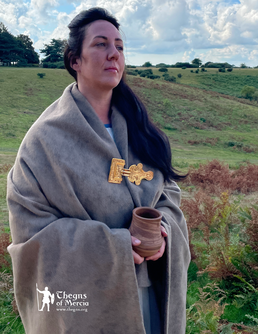 Costume impression of the mid c6th woman from Wasperton g24.
In part 2 (here) we explored the cemetery at Wasperton – a rare case of a community cemetery in continuous use from the Roman to early medieval period – and presented a costume reconstruction based on one 6th century woman’s burial, with a particularly diverse array of jewellery and textiles which provide a compelling image of the interaction of different influences and fashions adopted by the folk who lived here at a ‘crossroads’ between cultures.
Although there are many early medieval cemeteries in this zone – some exhibiting a proportionally more impressive array of grave-goods – Wasperton is one of very few to have been excavated relatively recently and subject to modern analysis. Unlike with other cemeteries in the valley (many excavated in the early 20th century) the work at Wasperton sheds light on phases of burial tradition, bioarchaeology, and the invaluable insights into textiles and costume locked within the mineralised remains on the backs of metal items – the ‘mud’ which, in the earlier days of cemetery excavation would’ve been ignored and scrubbed away. Our choice of a high-status woman’s burial as a case-study is partly justified by the fact that it is these burials, with their impressive copper-alloy jewellery on which textile remains can be preserved, which provide the richest seam of information for costume more broadly. Lower-status burials, or burials from phases in which such elaborate grave-goods were not included, unfortunately yield little to no information with which costumes can be reconstructed, and it is for this reason that costume presentations skew towards high status, and towards phases with well-furnished burials.
Information concerning mens costume is also proportionally scarcer within these cemeteries, with mens dress including fewer metal items on which textiles can be preserved (Walton-Rogers, 2007). Setting aside the famous but highly atypical princely burials of the late 6th to 7th centuries, masculine grave-goods assemblages from furnished burials within cemeteries tend to have (and to some extent are defined by) an absence of anything which could be described as jewellery: the only common metal dress-item being a buckle at the waist, which even in putatively ‘high status’ / well-furnished burials can often be small, utilitarian and plain. The extremely limited textile remains tend to come from these buckles, only found at the waist, providing little evidence directly representing the form and construction of garments without reference to more complete examples of clothing from adjacent periods and cultures. Well-furnished male burials instead tend to stand out through the inclusion of non-costume-related objects – particularly weapons and shields – though represented primarily by degraded iron remains, these still typically appear superficially less impressive than the equivalent feminine assemblages. The true impressiveness of such items can only be revealed through deeper analysis (particularly via radiography and metallography) and visualised by reconstruction.
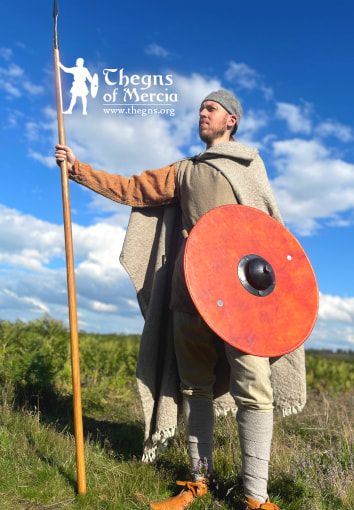
Complimenting the costume reconstruction already presented based on Wasperton G24, here we present the results of team member Marc Smith’s project to represent another of the 242 burials from the same cemetery: grave 91.
Although there are many early medieval cemeteries in this zone – some exhibiting a proportionally more impressive array of grave-goods – Wasperton is one of very few to have been excavated relatively recently and subject to modern analysis. Unlike with other cemeteries in the valley (many excavated in the early 20th century) the work at Wasperton sheds light on phases of burial tradition, bioarchaeology, and the invaluable insights into textiles and costume locked within the mineralised remains on the backs of metal items – the ‘mud’ which, in the earlier days of cemetery excavation would’ve been ignored and scrubbed away. Our choice of a high-status woman’s burial as a case-study is partly justified by the fact that it is these burials, with their impressive copper-alloy jewellery on which textile remains can be preserved, which provide the richest seam of information for costume more broadly. Lower-status burials, or burials from phases in which such elaborate grave-goods were not included, unfortunately yield little to no information with which costumes can be reconstructed, and it is for this reason that costume presentations skew towards high status, and towards phases with well-furnished burials.
Information concerning mens costume is also proportionally scarcer within these cemeteries, with mens dress including fewer metal items on which textiles can be preserved (Walton-Rogers, 2007). Setting aside the famous but highly atypical princely burials of the late 6th to 7th centuries, masculine grave-goods assemblages from furnished burials within cemeteries tend to have (and to some extent are defined by) an absence of anything which could be described as jewellery: the only common metal dress-item being a buckle at the waist, which even in putatively ‘high status’ / well-furnished burials can often be small, utilitarian and plain. The extremely limited textile remains tend to come from these buckles, only found at the waist, providing little evidence directly representing the form and construction of garments without reference to more complete examples of clothing from adjacent periods and cultures. Well-furnished male burials instead tend to stand out through the inclusion of non-costume-related objects – particularly weapons and shields – though represented primarily by degraded iron remains, these still typically appear superficially less impressive than the equivalent feminine assemblages. The true impressiveness of such items can only be revealed through deeper analysis (particularly via radiography and metallography) and visualised by reconstruction.
Complimenting the costume reconstruction already presented based on Wasperton G24, here we present the results of team member Marc Smith’s project to represent another of the 242 burials from the same cemetery: grave 91.
 RSS Feed
