Thegns of Mercia
  • About Us
  • Services
    • Living History >
      • Events Calendar
    • Talks & Workshops
    • Reconstructions
    • Recent Reconstructions
  • TV & Film
  • Blog
  • Contact Us
  • 2026 Aeftergeola Winterfeorm

Folk of the Avon Valley (3): Wasperton 'Warrior'

12/4/2024

Comments

 
Picture
In previous chapters we began an exploration of the archaeology representing an early ‘Anglo-Saxon’ or perhaps more accurately ‘Anglo-British’ community which lived along the Warwickshire & Worcestershire Avon valley in the 5-7th centuries, in a chain of settlements along a westward flowing river in an area – the West Midlands – generally regarded as the western frontier of ‘Anglo-Saxon’ activity. This community provides perhaps the perfect case-study for getting to grips with the complexities of late antiquity in Britain, with themes of both continuity and change, and the interplay and transformation of identities after Roman withdrawal, leading ultimately to the emergence of coherent Anglo-Saxon kingdoms.
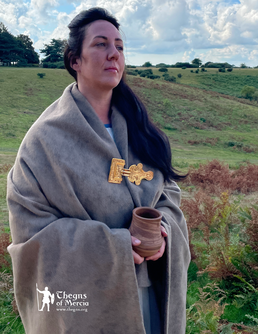
PictureCostume impression of the mid c6th woman from Wasperton g24.
In part 2 (here) we explored the cemetery at Wasperton – a rare case of a community cemetery in continuous use from the Roman to early medieval period – and presented a costume reconstruction based on one 6th century woman’s burial, with a particularly diverse array of jewellery and textiles which provide a compelling image of the interaction of different influences and fashions adopted by the folk who lived here at a ‘crossroads’ between cultures.

Although there are many early medieval cemeteries in this zone – some exhibiting a proportionally more impressive array of grave-goods – Wasperton is one of very few to have been excavated relatively recently and subject to modern analysis. Unlike with other cemeteries in the valley (many excavated in the early 20th century) the work at Wasperton sheds light on phases of burial tradition, bioarchaeology, and the invaluable insights into textiles and costume locked within the mineralised remains on the backs of metal items – the ‘mud’ which, in the earlier days of cemetery excavation would’ve been ignored and scrubbed away. Our choice of a high-status woman’s burial as a case-study is partly justified by the fact that it is these burials, with their impressive copper-alloy jewellery on which textile remains can be preserved, which provide the richest seam of information for costume more broadly. Lower-status burials, or burials from phases in which such elaborate grave-goods were not included, unfortunately yield little to no information with which costumes can be reconstructed, and it is for this reason that costume presentations skew towards high status, and towards phases with well-furnished burials.

Information concerning mens costume is also proportionally scarcer within these cemeteries, with mens dress including fewer metal items on which textiles can be preserved (Walton-Rogers, 2007). Setting aside the famous but highly atypical princely burials of the late 6th to 7th centuries, masculine grave-goods assemblages from furnished burials within cemeteries tend to have (and to some extent are defined by) an absence of anything which could be described as jewellery: the only common metal dress-item being a buckle at the waist, which even in putatively ‘high status’ / well-furnished burials can often be small, utilitarian and plain. The extremely limited textile remains tend to come from these buckles, only found at the waist, providing little evidence directly representing the form and construction of garments without reference to more complete examples of clothing from adjacent periods and cultures. Well-furnished male burials instead tend to stand out through the inclusion of non-costume-related objects – particularly weapons and shields – though represented primarily by degraded iron remains, these still typically appear superficially less impressive than the equivalent feminine assemblages. The true impressiveness of such items can only be revealed through deeper analysis (particularly via radiography and metallography) and visualised by reconstruction.
​
Complimenting the costume reconstruction already presented based on Wasperton G24, here we present the results of team member Marc Smith’s project to represent another of the 242 burials from the same cemetery: grave 91. 

Read More
Comments

Folk of the Avon Valley (1) : Return to Bidford

1/9/2023

Comments

 
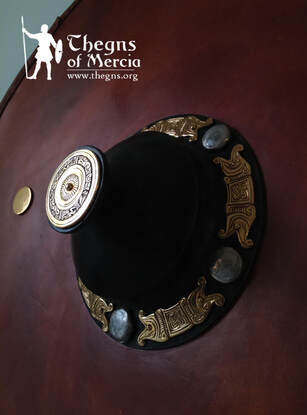
PictureShield from Bidford grave 182 (reconstruction by Æd & Andrew Thompson, Jason Green / Wieland Forge & George Easton / Danegeld)
​Though widely regarded as poor in early Anglo-Saxon (5-7th century) cemetery material, the West Midlands is home to some spectacular cemetery finds, most of which, excavated prior to modern archaeology and not on public display, remain obscure even to specialists.

Many of these finds originate from a chain of community burial sites along the river Avon in the south Midlands (Warwickshire & Worcestershire). Situated between the territory of what would later emerge as the kingdoms of Mercia and Wessex, the people buried here in the 5-6th century belonged to neither, yet are enmeshed in the origins of both. This community was also sandwiched between conclusively 'Anglian' territory and the Welsh Kingdoms, so might better be termed 'Anglo-British' than 'Anglo-Saxon', with clear signs of local Romano-British continuity intermingling with migration and change. Living in a 'transport triangle' criss-crossed by Roman-roads and navigable rivers, this community arguably provides the perfect case-study for engaging with the complexity of ethnogenesis / identity formation, and transformation, from late antiquity into the early medieval period in lowland Britain. 
​
In recent years we have undertaken a long-running project to re-create some of these treasures, to raise awareness of these amazing finds hitherto not on public display, and in particular, to reconstruct the image of a series of individuals from this 6th century community, based on the archaeology of specific burials, providing an opportunity to come 'face-to-face' with the folk who lived in the heart of what is now England, at the crossroads of kingdoms, 1500 years ago.

These reconstructions were unveiled at a series of public events at Sutton Hoo (National Trust) in summer 2023.


Read More
Comments

Shield of an Anglo-Saxon Prince - Part 3:  Painting

25/4/2022

Comments

 
Compared to the famous shield from Sutton Hoo Mound 1, the shields from the other treasure-filled princely Anglo-Saxon burials lack ostentatious decorative fittings. In the first chapter (link) we discussed the striking similarity of these shields, which appeared to be high-performance gear for warrior princes, optimised for agility rather than ostentation. In the second chapter (link) we reported on our project to produce an authentic replica of such a shield, and explore just how light weight they could have been. 
Picture
Despite the minimal fittings, its hard to imagine the shields of the late 6th century princely burials were entirely plain, and new evidence has come to light concerning early Anglo-Saxon paints, and the painted designs preserved from the late Iron Age, which has allowed us to more confidently wade into the painting of early Anglo-Saxon shields for the first time.
​
Researching and experimenting these paints, exploring the evidenced designs, and how they relate to decorative motifs seen in other media across both Anglo-Saxon material culture and adjacent cultures, we were finally able to finish our replica princely shield with a plausible painted design.

Read More
Comments

Shield of an Anglo-Saxon Prince - Part 2:  Building the Shield

19/3/2022

Comments

 
Picture
Aside from the magnificently decorated, heavy shield from Sutton Hoo Mound 1, remains of early Anglo-Saxon shields suggest they were typically relatively plain. Curiously the shields from the other treasure-filled princely burials – Taplow, Broomfield, Prittlewell, Sutton Hoo Mound 17 and others appear especially so, not befitting the status of these burials, with little in the way of decorative fittings, and very minimal, unusually simplified bosses. 
​
In the previous chapter (link) we revealed that (in contrast to the wide variability of shields from contemporary graves) the late 6th century princely burial shields were all practically identical, with suites of four simple disc mounts on the board, simple 1a(i) iron grip reinforcers, and innovative SB-4b / Dickinson’s Type 6 shield bosses – the smallest and lightest of all Anglo-Saxon bosses. In a number of these cases the boards were also made of ultra-light-weight willow. This is the lightest combination of fittings possible, among those evidenced from early Anglo-Saxon graves.   We have therefore argued that the princely shields represent a class of very carefully made, high-performance versions of the standard Anglo-Saxon shield, with weight-reduction prioritised over ostentation.
​
In 2021 we undertook a project to reconstruct such a shield – to explore precisely how light such a shield could be for a given diameter, and to explore methods consistent with archaeological clues which might have been employed to embellish such shields, commensurate with the status of their owners, without compromising their performance.  The result would provide a theoretical minimum weight for an early Anglo-Saxon shield of practical size, and represent our tenth and most ‘authentic’ shield reproduction to date. 


Read More
Comments

Shield of an Anglo-Saxon Prince - Part 1:  Surprising Discoveries

30/7/2021

Comments

 
PictureSutton Hoo Mound 1 Shield ( (C) British Museum)
Shields were arguably the most crucial and universal tool of the Anglo-Saxon battlefield, and their degraded remains - mainly iron fittings - are fairly frequent finds from early Anglo-Saxon graves. While most shields appear. at least in terms of metal fittings, to have been relatively plain, the famous kingly shield from Sutton Hoo Mound 1 was enormously elaborate and ostentatious, with fierce and glittering golden animal fittings, a bronze rim, and an elaborately decorated shield boss integrating embossed foils and garnets. Between these extremes its fair to assume the visual impact of shields reflected the status of its owner, but what of the shields from the other famous treasure-filled princely burials? Were they similarly impressive? 
​
Detailed examination of the remains of these lesser-known 'princely' shields reveals a number of surprises.... 


Read More
Comments

Shield of the Staffordshire Hoard

25/5/2019

Comments

 
Picture"Eagle and fish" gold sheet fitting from the Stafforshire Hoard. (Source: Wikimedia Commons, CC 2.0).
"Armed with the precedent set by the Sutton Hoo Mound 1 shield, pieces of possible shield-decoration from the Staffordshire Hoard, and current understanding of 7th century shield evolution, we embarked on a project to produce a shield that would not look out of place in the hands of Penda, Oswald, or one of their lieutenants. "

Nothing is more synonymous with Anglo-Saxon archaeology and history than the fabulous treasures which were uncovered in 1939 at Sutton Hoo, yet there is nothing “typical” or “representative” about the vast majority of this truly remarkable assemblage.  The enormous highly decorated shield, for example, integrating hundreds of components, lacks any particularly appropriate English parallels, and its closest comparators come from similarly impressive burials from the roughly contemporaneous Vendel Culture in Eastern Sweden.  So remarkable and “exotic” is the Sutton Hoo Mound 1 (SHM1) shield, that the still foremost study of Early Anglo-Saxon Shields; Dickinson & Härke (1992) all but excluded it from consideration. Anglo-Saxon shields with even modest metallic decoration (such as appliques or boss apex discs hardly visible except at very close quarters) are exquisitely rare and occur mainly from the mid 6th century; it is unclear to what extent this reflects a decline in the fashion or is simply an already rare item among furnished burials becoming invisible with the decline of the rite itself. Variation in the lavishness of shield ornamentation could be a battlefield indicator of rank and status, though most fittings are too small to have been particularly visible in this context, and although it is possible to sort the limited sample of decorated shields into “ranks” of embellishment (Dickinson (2005) and Mortimer (2011)) there is a danger of implying false near-equivalence between the only “top rank” shield of SHM1, and “second rank” shields (the most elaborate from the more commonly regarded “English sample”) such as 6th century Bidford-182 (see our reconstruction and article here) and the Tranmer House Shield (Sutton Hoo Grave 868), which are, in terms of crude count of components, at least 20 times less elaborate. Given extremely limited organic preservation, painted designs, wooden or leather appliques might be feasible, but the picture from grave archaeology is that, despite being the largest, most conspicuous “display surface”, even a high-status Anglo-Saxon warrior’s shield would have looked quite plain.
Contrary to this picture from undisturbed grave-shield finds, fragments of decoration from the robbed Sutton-Hoo Mound 2 (SHM2) equivalent to elements of the SHM1 shield suggest that the latter was not, in fact, unique, and the enormous abundance of jewelled 7th century “warrior bling” in the Staffordshire Hoard (STH / “the Hoard”) provides overwhelming evidence for conspicuous wealth and status display, in the form of jewelled war-gear, on the battlefields of the early-to-middle Anglo-Saxon period.  The most senior battle-companions of the occupant of SHM1 (probably Raedwald – King of the East Angles) would likely be similarly bejewelled, and so would other 7th century kings particularly characters like Edwin and Oswald of Northumbria, and Penda of Mercia, who, through political manoeuvring and conquest would succeed Raedwald as notional holders of Anglian “imperium”; it is hard to imagine these warrior kings – wearers of bejewelled helmets and wielders of gold-hilted swords – not having similarly impressive shields.
​
Armed with the precedent set by the SHM1 shield, pieces of possible shield-decoration from the Staffordshire Hoard, and current understanding of 7th century shield evolution, we embarked on a project to produce a shield that would not look out of place in the hands of Penda, Oswald, or one of their lieutenants.

Read More
Comments

    Thegns Blog

    Exploring the history, archaeology and cultures of the "Anglo-Saxon Period" (encompassing the Migration and Viking Ages).

    Archives

    May 2024
    April 2024
    October 2023
    September 2023
    July 2023
    April 2023
    March 2023
    February 2023
    November 2022
    June 2022
    April 2022
    March 2022
    February 2022
    July 2021
    April 2021
    March 2021
    February 2021
    December 2019
    September 2019
    May 2019
    January 2018
    December 2017

    Categories

    All
    Andalus
    Anglo Saxon
    Archaeology
    Architecture
    Arms And Armour
    Art
    Auseklis
    Avon Valley
    Byzantine Empire
    Christianity
    Coins
    Coronation
    Cosmology
    Dyes
    Experimental Archaeology
    Farming
    Fashion
    Festivals
    Food & Drink
    Frankish Empire
    History
    Kingship
    Knives
    Language
    Leatherwork
    Magic
    Migration Period
    Music
    Norman
    Old English
    Opinion
    Pagan
    Philosophy
    Poetry
    Princely Burials
    Prittlewell
    Reenactment
    Religion
    Roman
    Seasons
    Secrets In The Stones Series
    Shields
    Sociology
    Staffordshire Hoard
    Sutton Hoo
    Swords
    Symbology
    Taplow
    Textiles
    Thegns Reconstructions
    Trade
    Traditions
    Viking
    Women

    RSS Feed