Thegns of Mercia
  • About Us
  • Services
    • Living History >
      • Events Calendar
    • Talks & Workshops
    • Reconstructions
    • Recent Reconstructions
  • TV & Film
  • Blog
  • Contact Us

Coronation

24/4/2023

Comments


Special:    Anglo-Saxon Elements of the Coronation
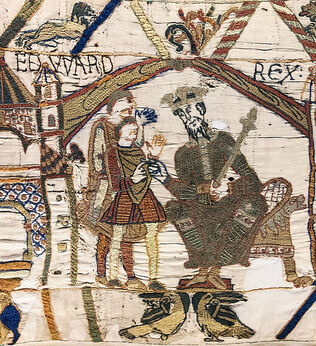
PictureEdward the Confessor on the Bayeux Tapestry
The approaching coronation of King Charles III represents a chain of similar coronation or consecration rites of monarchs in Britain reaching back at least 1000 years. The precise origins of many of these rites have been lost to time. 
​
Over all though, with the history of the English monarchy often presented as beginning with William the Conqueror's coronation on Christmas Day 1066 at Westminster Abbey, it's easy to imagine Britain's deeper history is not represented in the ceremony. In fact, although less obvious than later medieval elements, there are significant parts of the  coronation rite which reach back to, or attempt to reach out to (widest sense) Anglo-Saxon history. 
​


Read More
Comments

Anglo-Saxon Temple Discovered

2/4/2023

Comments

 
​This article is part of a series about our increasing understanding of the meanings behind the designs of Anglo-Saxon art. For other chapters click here.

​
​Secrets in the Stones: Decoding Anglo-Saxon Art. Part 3
​
Early Anglo-Saxon Temple Discovered
Picture
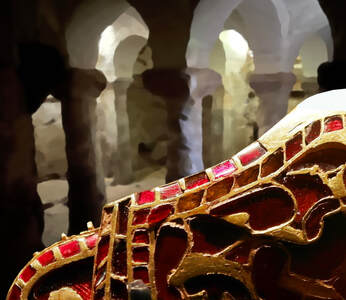
A gold-and-garnet pommel from the Staffordshire Hoard, which once adorned the jewelled hilt of the sword of an early Anglo-Saxon prince or king, shows what appear to be vaults or arches beneath 'triangular pediments', hiding in the patterns of its garnets. 

Once dismissed as an imaginative vision of the architecture of Rome by a culture whose architecture was limited to wooden huts and halls, new analysis we present here supports a radically different interpretation: that the pommel is a precise representation of a sophisticated and uniquely 'Anglo-Saxon' building, made decades or even centuries before such structures were previously thought to exist. 
Could this sword mount provide the earliest glimpses of a lost Anglo-Saxon temple?


Read More
Comments

Anatomy of Early Anglo-Saxon Swords

25/3/2023

Comments

 
Picture
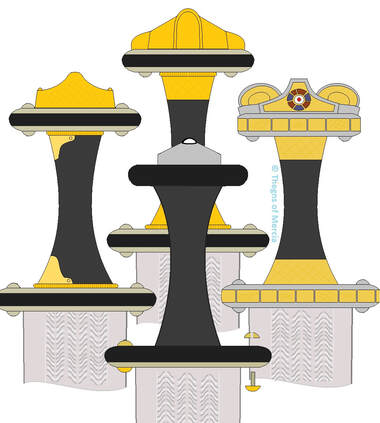
Although most swords from early Anglo-Saxon burials had relatively simple, entirely or largely organic hilts, more elaborate early Anglo-Saxon swords, as well as those of similar designs from related cultures in Migration Period and Early Medieval Europe and 'pre-Viking' Scandinavia, had hilts assembled from many different components.
 
The Staffordshire Hoard, discovered in 2009, contains the remains of between 80 and 150 bejewelled sword hilts, all having been ripped from their original blades. It can be difficult to keep track of the terms for all these various components, and how they relate to each-other. To reduce confusion when discussing Anglo-Saxon sword parts, we've prepared this illustrated guide, to help. 


Read More
Comments

Follow the Lozenges

21/3/2023

Comments

 
​This article is part of a series about our increasing understanding of the meanings behind the designs of Anglo-Saxon art. For other chapters click here.

​Secrets in the Stones: Decoding Anglo-Saxon Art. Part 2
​
Follow the Lozenges

Picture
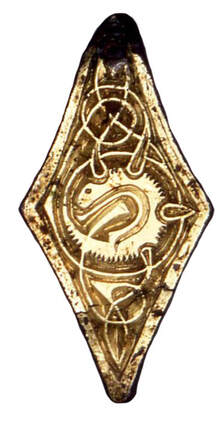
The early to middle Anglo-Saxon period saw a number of shifts in fashion - often radical and sudden. Examples include the adoption of animal interlaces, or the adoption of filigree and lapidary work over earlier carved-and-cast decoration on items like brooches and buckles, in the late 6th century.
Due to the decline of furnished burials the fashions of the late 7th to 8th centuries were previously largely unknown to us, but a growing number of finds reported to the Portable Antiquities Scheme has allowed a previously unknown brooch type to be categorized. These were bizarre - fragile, and of a radically different design than earlier types, but were of a very specific, highly conserved shape, and appear to have become the main high-status dress item of the period.  Why were they designed in this way? What, if anything, did they signify?   

Our team began discussing this strange fashion in 2020. Little did we know where the trail of the lozenge brooch would lead.... 


Read More
Comments

Anglo-Saxon Yule

21/11/2022

Comments

 
How did folk in early medieval lowland Britain spend the coldest and darkest time of the year?  What evidence do we have for their midwinter traditions, how did they change and evolve during the period, and have any survived to influence our own festive traditions today?

In preparation for a special midwinter event and seasonal exhibition at the most famous early Anglo-Saxon archaeological site - Sutton Hoo, and building on an earlier article on this subject published in 2012, we embarked on a project to re-examine the evidence for Anglo-Saxon midwinter traditions.  Though noting the existence of a well established image of a generalized early medieval Yule based on passed-down folk traditions and logical inferences is held dear by many people today, we found that many traditions assumed to be Anglo-Saxon in origin are absent from primary sources from the period and are first documented surprisingly late. On the other hand, we found evidence for surprisingly familiar traditions established during the Anglo-Saxon period which can be thought of as distant ancestors of aspects of modern Christmas we still observe today.
So don your warmest cloak, grab a horn-full of mead, and join us on a journey through time, back to the Anglo-Saxon midwinter festival known as Yule.
Picture

Read More
Comments

A Woman as King? The Secret Legacy of Æthelflæd, Lady of the Mercians

1/6/2022

Comments

 
At the time of writing a season of celebrations is underway for the Platinum Jubilee of Queen Elizabeth II, marking her 70 years as reign as monarch of the UK and Commonwealth.  Such a long reign is historically unprecedented and means that the overwhelming majority of people living in countries where she serves as head of state have no living memory of the reign of another monarch. In turn this also means that few have any memory of the reign of a king; a woman as head of state in these realms feels perfectly normal - even 'default' - and we have grown up talking of the history of "kings and queens" as if the words and roles have always carried equal weight. Historically this was not the case. Centuries ago, that which now goes without saying -that a woman could rule, competently and successfully in her own right - was a truly revolutionary idea. It only became accepted as the result of the examples set by a series of remarkable female rulers in Britain and the twists of fate which crowned them and tested them. 
Picture
Æthelflæd, Lady of the Mercians. (Credit: Jennifer Peters)
Though certainly not the first female ruler on these islands, a disproportionate debt is owed to one remarkable lady in particular, who lived eleven centuries ago. Emerging from an age and culture in which female leadership was largely unthinkable and all but unprecedented, she took power only reluctantly, and ruled with such brilliance that any doubt in female leadership would have been banished. But in so doing, she established a dangerous precedent, leading men to try, and thankfully, fail, to erase her from history....

Read More
Comments
<<Previous

    Thegns Blog

    Exploring the history, archaeology and cultures of the "Anglo-Saxon Period" (encompassing the Migration and Viking Ages).

    Archives

    May 2024
    April 2024
    October 2023
    September 2023
    July 2023
    April 2023
    March 2023
    February 2023
    November 2022
    June 2022
    April 2022
    March 2022
    February 2022
    July 2021
    April 2021
    March 2021
    February 2021
    November 2019
    September 2019
    May 2019
    January 2018
    December 2017

    Categories

    All
    Andalus
    Anglo Saxon
    Archaeology
    Architecture
    Arms And Armour
    Art
    Auseklis
    Avon Valley
    Byzantine Empire
    Christianity
    Coins
    Coronation
    Cosmology
    Dyes
    Experimental Archaeology
    Farming
    Fashion
    Festivals
    Food & Drink
    Frankish Empire
    History
    Kingship
    Knives
    Language
    Leatherwork
    Magic
    Migration Period
    Music
    Norman
    Old English
    Opinion
    Pagan
    Philosophy
    Poetry
    Princely Burials
    Prittlewell
    Reenactment
    Religion
    Roman
    Seasons
    Secrets In The Stones Series
    Shields
    Sociology
    Staffordshire Hoard
    Sutton Hoo
    Swords
    Symbology
    Taplow
    Textiles
    Thegns Reconstructions
    Trade
    Traditions
    Viking
    Women

    RSS Feed