
In the previous chapter we briefly introduced the early ‘Anglo-Saxon’, or perhaps more accurately ‘Anglo-British’ community which lived along the Warwickshire & Worcestershire Avon valley in the 5th-7th centuries, represented by a chain of settlement sites and cemeteries along this westward-flowing river in an area – the West Midlands – which has generally been regarded as the western frontier of ‘Anglo-Saxon’ activity. We discussed how the situation of this community makes them an ideal case-study for getting to grips with the complexities of late antiquity – of continuity and change, the arrival of new people and new fashions, and how identity formed and transformed in lowland Britain in the period between the Roman withdrawal and the emergence of coherent Anglo-Saxon kingdoms.
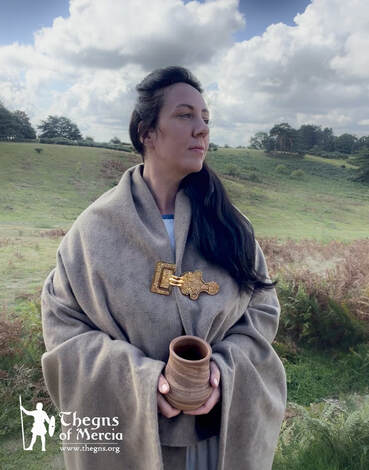
Whereas overarching narratives of this period are so often dominated by the archaeology of the south and east coast, it is perhaps these inland places at the crossroads between kingdoms (Tompkins, 2017) where we might get a better glimpse of the themes and processes affecting lowland Britain as a whole. However, with many of its sites excavated prior to modern archaeology, and with their finds not displayed, this region is hugely overlooked, and barely features in public-facing discourse about the Anglo-Saxon period or the processes which led to the formation of the kingdom of England. To address this, we embarked on a three-year project to reconstruct an image of three individuals from this community-chain, based on remains from specific burials and to raise awareness of the archaeology of this region.
Many cemeteries in this region with fascinating finds were excavated prior to modern archaeology considerably challenging efforts to reconstruct burial assemblages (a problem we have discussed previously and will return to in a later chapter discussing the reconstruction of an assemblage from Bidford-on-Avon) but one cemetery in particular was meticulously excavated in the mid 1980s by some of the UK’s leading early medieval specialists, and after a lengthy delay its archaeology was analysed and finally published in 2009. The themes which emerged from the analysis of the ‘Roman, British and Anglo-Saxon Community’ cemetery at Wasperton challenged many of the existing assumptions and entrenched debates about the arrival of the ’Anglo-Saxons’, changing burial practices, expression of identity, and the emergence of ‘Anglo-Saxon’ kingdoms (Carver et. al., 2009) in ways that have perhaps still not fully had chance to work through.
The archaeology here was, for an early medieval cemetery, almost uniquely long-lived and continuous, diverse, and did not fit with any particular simplistic model of settlement or change. Argued to ‘raise more questions than it answers’ the cemetery at Wasperton represents a local community, in the heart of what is now England – always diverse, highly networked with other regions, continually renegotiating its identity, and adapting or responding to outside change.
Seeking to raise awareness of this fascinating archaeology, here we present and discuss work led by Thegns of Mercia member and historic costume expert Lindsey Catlin to reconstruct the appearance of one individual from this late antique Anglo-British community based on remains from one of 242 burials in the Wasperton cemetery.
Many cemeteries in this region with fascinating finds were excavated prior to modern archaeology considerably challenging efforts to reconstruct burial assemblages (a problem we have discussed previously and will return to in a later chapter discussing the reconstruction of an assemblage from Bidford-on-Avon) but one cemetery in particular was meticulously excavated in the mid 1980s by some of the UK’s leading early medieval specialists, and after a lengthy delay its archaeology was analysed and finally published in 2009. The themes which emerged from the analysis of the ‘Roman, British and Anglo-Saxon Community’ cemetery at Wasperton challenged many of the existing assumptions and entrenched debates about the arrival of the ’Anglo-Saxons’, changing burial practices, expression of identity, and the emergence of ‘Anglo-Saxon’ kingdoms (Carver et. al., 2009) in ways that have perhaps still not fully had chance to work through.
The archaeology here was, for an early medieval cemetery, almost uniquely long-lived and continuous, diverse, and did not fit with any particular simplistic model of settlement or change. Argued to ‘raise more questions than it answers’ the cemetery at Wasperton represents a local community, in the heart of what is now England – always diverse, highly networked with other regions, continually renegotiating its identity, and adapting or responding to outside change.
Seeking to raise awareness of this fascinating archaeology, here we present and discuss work led by Thegns of Mercia member and historic costume expert Lindsey Catlin to reconstruct the appearance of one individual from this late antique Anglo-British community based on remains from one of 242 burials in the Wasperton cemetery.
 RSS Feed
