Thegns of Mercia
  • About Us
  • Services
    • Living History >
      • Events Calendar
    • Talks & Workshops
    • Reconstructions
    • Recent Reconstructions
  • TV & Film
  • Blog
  • Contact Us

The Garnet Code

19/4/2023

 
​​This article is part of a series about our increasing understanding of the meanings behind the designs of Anglo-Saxon art. For other chapters click here.

​
​Secrets in the Stones: Decoding Anglo-Saxon Art. Part 4
​
Picture
The Garnet Code

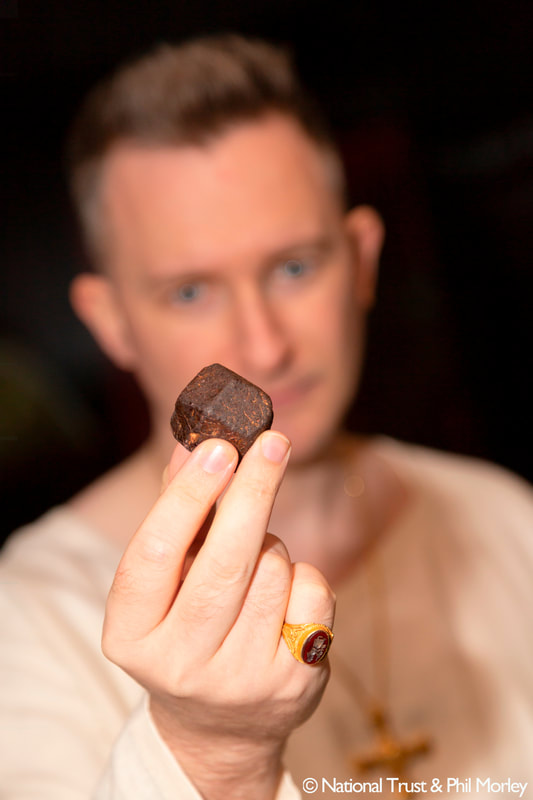
​Early Anglo-Saxon jewellery is renowned for its use of gold and garnet work. Until now, the significance of garnets as a material has not been thoroughly investigated. In this article, and a public lecture at Soulton Hall, Shropshire (delivered simultaneously with this article’s timed release) James D. Wenn draws together the geometry of the garnet crystal with the geometry within Anglo-Saxon art and architecture, signposting to the previous articles in this series. This is then coupled with later examples of this geometry, notably the Cosmati Pavement in Westminster Abbey, to link the philosophical meaning of this geometry to Plato’s book ‘Timaeus’, and both pre-Christian and Christian cosmology and theology.​


Read More

Anglo-Saxon Temple Discovered

2/4/2023

Comments

 
​This article is part of a series about our increasing understanding of the meanings behind the designs of Anglo-Saxon art. For other chapters click here.

​
​Secrets in the Stones: Decoding Anglo-Saxon Art. Part 3
​
Early Anglo-Saxon Temple Discovered
Picture
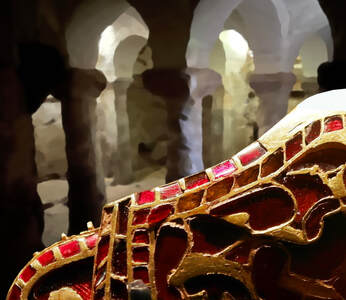
A gold-and-garnet pommel from the Staffordshire Hoard, which once adorned the jewelled hilt of the sword of an early Anglo-Saxon prince or king, shows what appear to be vaults or arches beneath 'triangular pediments', hiding in the patterns of its garnets. 

Once dismissed as an imaginative vision of the architecture of Rome by a culture whose architecture was limited to wooden huts and halls, new analysis we present here supports a radically different interpretation: that the pommel is a precise representation of a sophisticated and uniquely 'Anglo-Saxon' building, made decades or even centuries before such structures were previously thought to exist. 
Could this sword mount provide the earliest glimpses of a lost Anglo-Saxon temple?


Read More
Comments

Follow the Lozenges

21/3/2023

Comments

 
​This article is part of a series about our increasing understanding of the meanings behind the designs of Anglo-Saxon art. For other chapters click here.

​Secrets in the Stones: Decoding Anglo-Saxon Art. Part 2
​
Follow the Lozenges

Picture
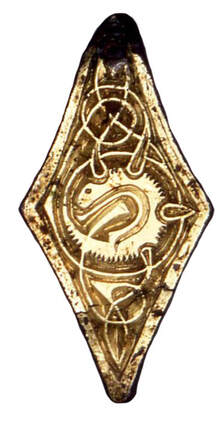
The early to middle Anglo-Saxon period saw a number of shifts in fashion - often radical and sudden. Examples include the adoption of animal interlaces, or the adoption of filigree and lapidary work over earlier carved-and-cast decoration on items like brooches and buckles, in the late 6th century.
Due to the decline of furnished burials the fashions of the late 7th to 8th centuries were previously largely unknown to us, but a growing number of finds reported to the Portable Antiquities Scheme has allowed a previously unknown brooch type to be categorized. These were bizarre - fragile, and of a radically different design than earlier types, but were of a very specific, highly conserved shape, and appear to have become the main high-status dress item of the period.  Why were they designed in this way? What, if anything, did they signify?   

Our team began discussing this strange fashion in 2020. Little did we know where the trail of the lozenge brooch would lead.... 


Read More
Comments

From Egypt to East Anglia: design in the Sutton Hoo scabbard bosses

5/3/2023

Comments


​Secrets in the Stones: Decoding Anglo-Saxon Art.  Part 1
​
From Egypt to East Anglia: design in the Sutton Hoo scabbard bosses

PictureSutton Hoo scabbard boss ( (C) Trustees of British Museum)
​This article is part of a series about our increasing understanding of the meanings behind the designs of Anglo-Saxon art. For other chapters click here. 

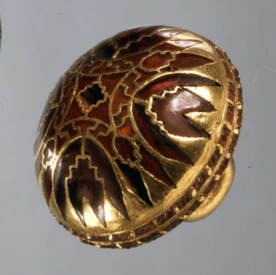
Amongst the glittering masses of gold and garnet treasure, from the Sutton Hoo royal burials in East Anglia and the Staffordshire Hoard to the smaller discoveries of furnished graves and chance finds, it can be hard to concentrate on individual pieces. In the scabbard bosses from Sutton Hoo, however, close inspection reveals an exciting possibility — that the people who created these masterpieces of jewellery not only had the most sophisticated craft skills, but also possessed mastery of classical philosophy from the Eastern Mediterranean.


Read More
Comments

​Secrets in the Stones: Decoding Anglo-Saxon Art (Introduction)

1/3/2023

Comments


​Secrets in the Stones: Decoding Anglo-Saxon Art
Introduction

This introduction is the first instalment of a series. For other chapters click here.
Picture
Once dismissed as frivolous and merely decorative, Anglo-Saxon artwork is increasingly recognised to be loaded with hidden meaning, but we have barely begun to decode this visual language. Doing so offers the potential to transform our understanding of this historical cultural network of the so-called “Dark Ages” as a significant world civilization.

New research by Thegns of Mercia member James D. Wenn, focused on a seemingly unrelated subject area, and a series of chance discoveries, have led to transformative new learning perspectives with wide-ranging implications. A book (to be published soon) will lay out many of these discoveries, with key concepts discussed in an upcoming public lecture in April 2023, but neither can fully document the application of these new perspectives on the corpus of Anglo-Saxon art. In the coming weeks we will, therefore, be publishing a special series of articles, here, which will explore the decoding of Anglo-Saxon art made possible by these perspectives.


Read More
Comments

'Queer / LGBT+ Heroes' of Early Medieval Europe

26/2/2022

Comments

 
Picture
Picture
Each February in the UK is LGBT+ History Month; a time to celebrate the contributions of LGBT+ people and a chance to shed new light on the history of ‘queer’ people. Our organization would not exist without the contributions of LGBT+ / ‘queer’ members and we are strongly committed to maintaining an inclusive atmosphere within the group for people of all sexualities, gender identities and expressions, and celebrating the achievements of all members of our team.

​​It’s easy to imagine that diversity of sexuality and gender expression is a modern phenomenon, framed
as it is by modern terminology, norms, and ways of defining identity, but such diversity has always existed.​ Folk of ancient cultures would not recognise the ways we define such identities today, but 'Queerness' in its broadest sense (see notes on terminology, below) has always been with us, often accompanied by familiar challenges in navigating a largely heteronormative world, and in finding acceptance, which many of us would recognise and can identify with today.

Notable, oft-cited examples include the well-documented homoromantic relationships of Roman Emperors or certain later medieval kings, the gender-transcending priests of Cybele and Attis, or widespread, celebrated homosexuality in Ancient Greece. Sandwiched between the better-documented Classical and later Medieval period though, the Migration / Early Medieval period which we often cautiously refer to here as the 'Anglo-Saxon Period' is rarely mentioned in the context of historical 'queer' themes and figures. This risks creating the impression that natural diversity in sexuality and gender expression did not exist among the 'Anglo-Saxons', 'Vikings' and related cultures, enabling those hostile to such diversity to falsely identify with and appropriate these cultures, or rather, a mythical and distorted version of them, and to use their example to promote prejudice.

To whatever extent there is a lack of evidence for (broadest sense) 'queerness' in early medieval history this largely reflects a lack of documentary evidence which addresses matters of sexuality at all. The High Medieval blossoming of art and literature celebrating romantic love in NW Europe, for example, had not yet occurred, and aside from bawdy riddles, discussion of sexuality in surviving Anglo-Saxon literature is largely confined to the more or less guarded writings of clerics whose public status as celibate underpinned their acceptance in society as outside dynastic struggles and rivalries, and whose faith celebrated abstinence. That said, there are certainly figures from the period who, were they alive today might be considered 'queer'. To these can be added other exceptional figures who defied gender expectations and norms; trailblazers involved in the huge societal changes of the period, redefining what it meant to be a man or woman, facing challenges which LGBT+ / ‘queer’ people today would identify with. In discussing and remembering these individuals, we also remember the countless people who suffered and died from persecution targeting aspects of sexuality and gender expression in the period and throughout history.

With this in mind, here are some Early Medieval 'queeroes' from Europe; those who today could be thought of as LGBT+ / ‘queer’, and other historical figures from whose lives LGBT+ people might identify with.


Read More
Comments
<<Previous

    Thegns Blog

    Exploring the history, archaeology and cultures of the "Anglo-Saxon Period" (encompassing the Migration and Viking Ages).

    Archives

    May 2024
    April 2024
    October 2023
    September 2023
    July 2023
    April 2023
    March 2023
    February 2023
    November 2022
    June 2022
    April 2022
    March 2022
    February 2022
    July 2021
    April 2021
    March 2021
    February 2021
    December 2019
    September 2019
    May 2019
    January 2018
    December 2017

    Categories

    All
    Andalus
    Anglo Saxon
    Archaeology
    Architecture
    Arms And Armour
    Art
    Auseklis
    Avon Valley
    Byzantine Empire
    Christianity
    Coins
    Coronation
    Cosmology
    Dyes
    Experimental Archaeology
    Farming
    Fashion
    Festivals
    Food & Drink
    Frankish Empire
    History
    Kingship
    Knives
    Language
    Leatherwork
    Magic
    Migration Period
    Music
    Norman
    Old English
    Opinion
    Pagan
    Philosophy
    Poetry
    Princely Burials
    Prittlewell
    Reenactment
    Religion
    Roman
    Seasons
    Secrets In The Stones Series
    Shields
    Sociology
    Staffordshire Hoard
    Sutton Hoo
    Swords
    Symbology
    Taplow
    Textiles
    Thegns Reconstructions
    Trade
    Traditions
    Viking
    Women

    RSS Feed