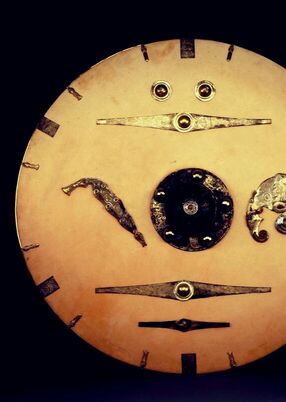
Sutton Hoo Mound 1 Shield ( (C) British Museum)
Detailed examination of the remains of these lesser-known 'princely' shields reveals a number of surprises....
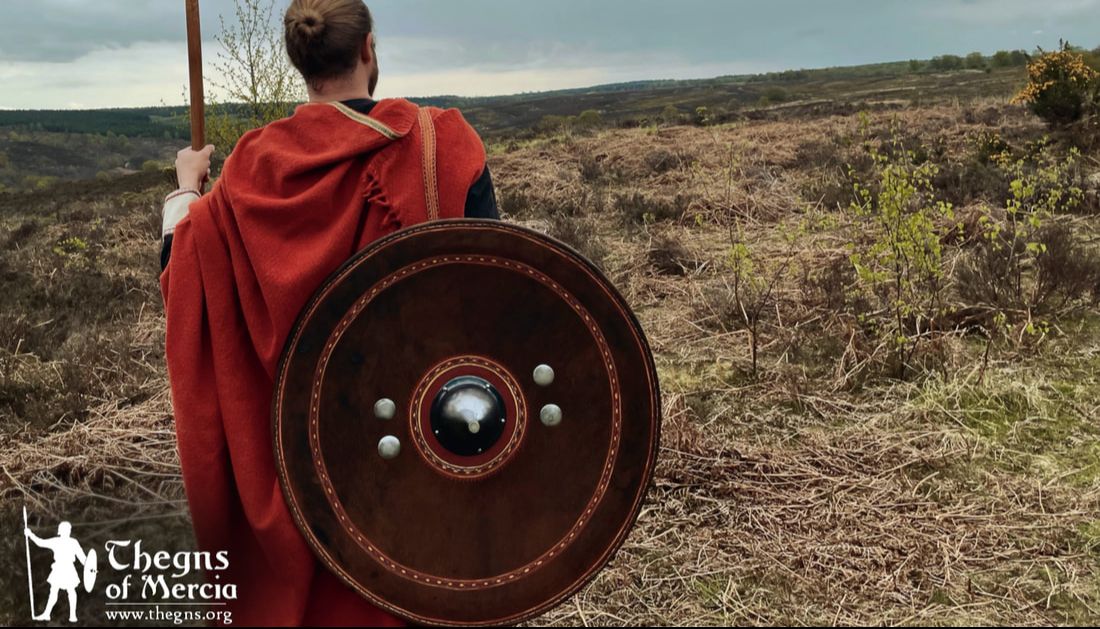
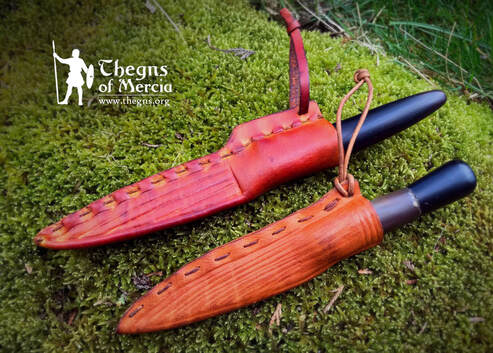
Sutton Hoo Mound 1 Shield ( (C) British Museum) Shields were arguably the most crucial and universal tool of the Anglo-Saxon battlefield, and their degraded remains - mainly iron fittings - are fairly frequent finds from early Anglo-Saxon graves. While most shields appear. at least in terms of metal fittings, to have been relatively plain, the famous kingly shield from Sutton Hoo Mound 1 was enormously elaborate and ostentatious, with fierce and glittering golden animal fittings, a bronze rim, and an elaborately decorated shield boss integrating embossed foils and garnets. Between these extremes its fair to assume the visual impact of shields reflected the status of its owner, but what of the shields from the other famous treasure-filled princely burials? Were they similarly impressive? Detailed examination of the remains of these lesser-known 'princely' shields reveals a number of surprises.... In the frequently damp environment of early medieval Britain and western Europe sheaths were essential for valuable ferrous blades, including swords, war-seaxes and smaller utility knives. The sophisticated and labour-intensive construction of sword scabbards, formed of animal-hair lined carved wooden plates enclosed in leather or hide (“skin product”) is evidence of the priority given to protecting blades. Well preserved examples of seax sheaths, mainly from productive leatherworking sites of the mid-to-late Anglo-Saxon period, at York and Gloucester (Cameron, 2000) as well as more trace evidence from earlier grave finds, demonstrates the high level of craftsmanship which went into these, usually of a single piece of folded and moulded skin-product, sometimes intricately decorated, as might be expected given that the sheath, and not the blade, was the most visible component of any seax assemblage day to day and therefore an important surface for wealth display. Vastly more common but nevertheless valuable personal possessions and often of sophisticated smithcraft, smaller utility and eating-knives also required tight-fitting sheaths of valuable skin-product, but despite the abundance of such knives in the archaeological record, for a wide range of reasons clues about the sheaths of smaller knives are scarcer than for larger seaxes. It might be reasonable, and has been the practice among more detail-oriented living historians and reenactors, to assume that sheaths of smaller knives in, for example, the early Anglo-Saxon period, might be miniature analogues of those of larger seaxes, yet fragmentary sheath remains from a handful of well-studied early Anglo-Saxon sites appear surprisingly crude, with amateurish stitching having unattractively contorted the seams in a way that might disgust a modern leatherworker. There is no reason not to think these examples are not well representative, and indeed, many of the later (Viking-Age) knife-sheath remains from York, though often skilfully decorated, bear the tell-tale marks and contortions of this same rudimentary stitch work. It is always tempting to base the sheaths of our knives on the very fanciest, and neatest archaeological examples to hand, and perhaps neaten them up with some more modern handiwork, but this can lead to a creeping departure from what is truly known of the historic craft culture purportedly represented. In contrast, replicating (to our modern eyes) “unbecoming” examples might provide useful, practical insights into why they were made this way. Such is the case with these apparently crudely stitched knife sheaths – our experiments in replicating them have revealed what might be a cunning Dark Age leatherworker’s “life-hack” which made the tricky shaping of sheaths vastly quicker and more reliable. Previously we unveiled reconstructions of two early Anglo-Saxon lyres based on remains from princely burials (link). Lyres were extremely precious and sensitive objects, so deserved special protection from knocks, but also from the constant wide changes in temperature and humidity which occurred daily both within and outside Anglo-Saxon halls. Many archaeological examples both from lowland Britain and contemporary graves in Europe show signs of repair in antiquity. The most extreme example, the Prittlewell lyre appears to have been cracked on both sides, and carefully pieced back together using small metal riveted strips acting as staples. Thankfully these burials also provide archaeological clues regarding the measures the Anglo-Saxons took to protect their musical instruments, with tantalising traces of cases. Partly based on these remains, here we present two alternative forms of lyre case which may have been used in the period, reconstructed by members Andrew and Æd Thompson. Few objects in early Anglo-Saxon archaeology are more evocative, than the so-called “warrior-lyres” or “hearpes” which have gradually emerged from analysis of mostly quite poorly preserved remains from some of the most famous 6-7th century burials. For those exploring this historic period, they also possess a unique power – transmitting to us another sensory dimension to enrich our sense of the Anglo-Saxon world. With accurately built replica lyres, we are granted the unique opportunity experience the sound of the 6-7th century mead hall, echoing across the centuries, which accompanied the first recorded stories and poems in our language. In autumn 2018, member Æd Thompson (having previously produced Dreamgifu – a reasonably faithful replica of the perfectly preserved 6th century Alemannic lyre from Trossingen) embarked on a project to produce two new lyres, of the (in some ways) more challenging Anglo-Saxon design. "Eagle and fish" gold sheet fitting from the Stafforshire Hoard. (Source: Wikimedia Commons, CC 2.0). "Armed with the precedent set by the Sutton Hoo Mound 1 shield, pieces of possible shield-decoration from the Staffordshire Hoard, and current understanding of 7th century shield evolution, we embarked on a project to produce a shield that would not look out of place in the hands of Penda, Oswald, or one of their lieutenants. " Nothing is more synonymous with Anglo-Saxon archaeology and history than the fabulous treasures which were uncovered in 1939 at Sutton Hoo, yet there is nothing “typical” or “representative” about the vast majority of this truly remarkable assemblage. The enormous highly decorated shield, for example, integrating hundreds of components, lacks any particularly appropriate English parallels, and its closest comparators come from similarly impressive burials from the roughly contemporaneous Vendel Culture in Eastern Sweden. So remarkable and “exotic” is the Sutton Hoo Mound 1 (SHM1) shield, that the still foremost study of Early Anglo-Saxon Shields; Dickinson & Härke (1992) all but excluded it from consideration. Anglo-Saxon shields with even modest metallic decoration (such as appliques or boss apex discs hardly visible except at very close quarters) are exquisitely rare and occur mainly from the mid 6th century; it is unclear to what extent this reflects a decline in the fashion or is simply an already rare item among furnished burials becoming invisible with the decline of the rite itself. Variation in the lavishness of shield ornamentation could be a battlefield indicator of rank and status, though most fittings are too small to have been particularly visible in this context, and although it is possible to sort the limited sample of decorated shields into “ranks” of embellishment (Dickinson (2005) and Mortimer (2011)) there is a danger of implying false near-equivalence between the only “top rank” shield of SHM1, and “second rank” shields (the most elaborate from the more commonly regarded “English sample”) such as 6th century Bidford-182 (see our reconstruction and article here) and the Tranmer House Shield (Sutton Hoo Grave 868), which are, in terms of crude count of components, at least 20 times less elaborate. Given extremely limited organic preservation, painted designs, wooden or leather appliques might be feasible, but the picture from grave archaeology is that, despite being the largest, most conspicuous “display surface”, even a high-status Anglo-Saxon warrior’s shield would have looked quite plain. Contrary to this picture from undisturbed grave-shield finds, fragments of decoration from the robbed Sutton-Hoo Mound 2 (SHM2) equivalent to elements of the SHM1 shield suggest that the latter was not, in fact, unique, and the enormous abundance of jewelled 7th century “warrior bling” in the Staffordshire Hoard (STH / “the Hoard”) provides overwhelming evidence for conspicuous wealth and status display, in the form of jewelled war-gear, on the battlefields of the early-to-middle Anglo-Saxon period. The most senior battle-companions of the occupant of SHM1 (probably Raedwald – King of the East Angles) would likely be similarly bejewelled, and so would other 7th century kings particularly characters like Edwin and Oswald of Northumbria, and Penda of Mercia, who, through political manoeuvring and conquest would succeed Raedwald as notional holders of Anglian “imperium”; it is hard to imagine these warrior kings – wearers of bejewelled helmets and wielders of gold-hilted swords – not having similarly impressive shields.
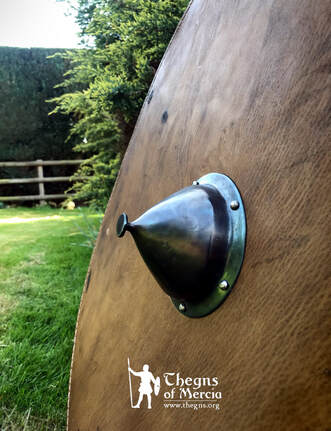
Armed with the precedent set by the SHM1 shield, pieces of possible shield-decoration from the Staffordshire Hoard, and current understanding of 7th century shield evolution, we embarked on a project to produce a shield that would not look out of place in the hands of Penda, Oswald, or one of their lieutenants. Although textile remains from the early Anglo-Saxon period are quite rare, painstaking analysis by textile archaeologists including Elizabeth Grace Crowfoot, Sonia Chadwick Hawkes, and Penelope Walton Rogers reveal tantalising glimpses of the surprisingly colourful world of Anglo-Saxon and Viking Age textiles. Having explored and experimented with plant-dyes for a number of years, we present here two projects to produce garments of the very brightest colours we could achieve with home grown plant dyes.
|
Thegns BlogExploring the history, archaeology and cultures of the "Anglo-Saxon Period" (encompassing the Migration and Viking Ages). Archives
May 2024
Categories
All
|